

Invacuation and lockdown are often spoken about as if they are the same thing. In practice, they describe different responses and the distinction matters. Understanding the difference helps organisations develop clearer emergency plans, choose proportionate responses and communicate calmly when it counts. Clarity of language directly supports clarity of action.
What invacuation means
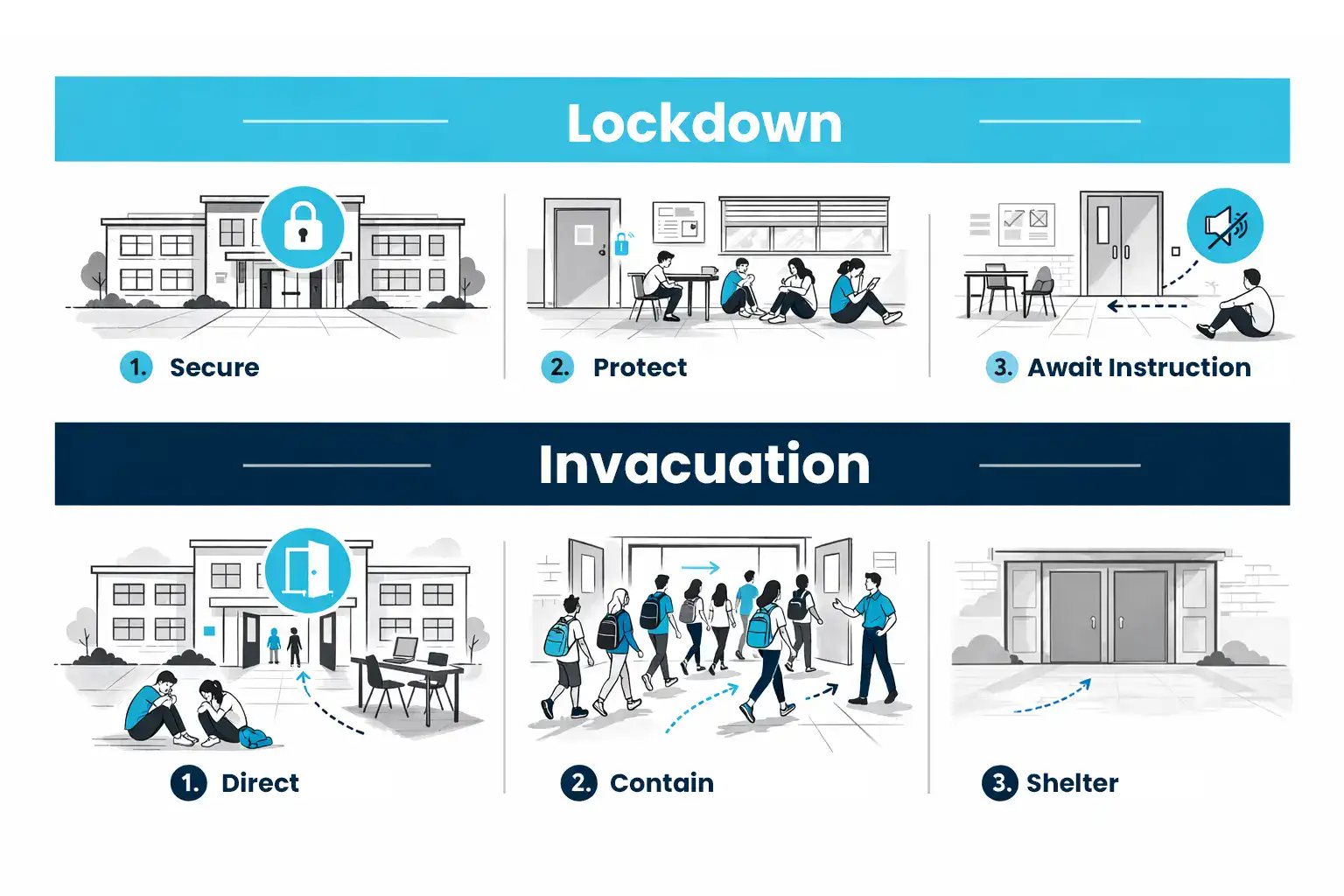
Invacuation refers to keeping people inside a building or moving them to safer internal areas rather than evacuating. An invacuation procedure is typically used when there is a potential risk outside the building, but no immediate need to restrict internal movement.
During an invacuation:
- people remain indoors
- normal activity may continue
- movement is not automatically restricted
- communication stays active and reassuring
- It is commonly used when there is a risk outside the building but no immediate need for tight security controls.
- In many education, civic and commercial environments, invacuation forms part of a wider operational resilience planning strategy.
What lockdown involves
Lockdown is a specific form of invacuation used when the level of risk is higher. A lockdown procedure is a specific form of invacuation used when the level of risk increases and greater control is required.
During a lockdown:
- movement within the building is restricted
- access points may be secured
- communication is more tightly managed
- occupants are directed to remain in designated areas
In some cases, organisations may implement a partial lockdown, perimeter lockdown, or phased lockdown, depending on the nature and location of the threat. Lockdown is about control and containment when circumstances demand it.
Dynamic Lockdown and Escalation
Emergency situations do not always remain static. An invacuation procedure may escalate into a lockdown if risk increases or de-escalate once more information becomes available. This approach is sometimes described as dynamic lockdown that allows organisations to adjust their response proportionately. Clear escalation pathways within lockdown procedures help prevent confusion and overreaction.
A simple way to remember the difference
Invacuation keeps people inside while allowing the building to function. Lockdown secures the building and limits movement. All lockdowns are invacuations, but not all invacuations are lockdowns.
Why the language matters
Using lockdown language when it is not needed can create unnecessary anxiety. Underplaying a situation can lead to confusion. Clear definitions help teams choose proportionate responses and communicate with confidence.
The role of communication systems
Both invacuation and lockdown depend on clear voice communication. People need to understand instructions, feel reassured and know that the situation is being managed. Dedicated emergency communication systems play a central role in supporting that clarity.
Where Baldwin Boxall supports the response
Clear language and clear communication go hand in hand. For decades we have worked with building operators to ensure that voice systems behave consistently when pressure rises. Our PA/VA range, VIGIL3, enables building management to deliver clear, live or pre-recorded instructions to an entire building simultaneously. By providing site-wide intelligible voice messages at the touch of a button, which helps ensure instructions are heard quickly and without ambiguity.
Solutions such as VIGIL 3, designed, manufactured and tested in the UK, are used in many of the environments where invacuation and lockdown planning now matters most.
Choosing the right response depends on people understanding instructions quickly and without confusion. Purpose designed life safety communication systems help make that possible while supporting calm and confident decision making.
As organisations refine their approach to emergency planning, particularly in the context of evolving security expectations, we continue to support clearer communication and proportionate response.


